
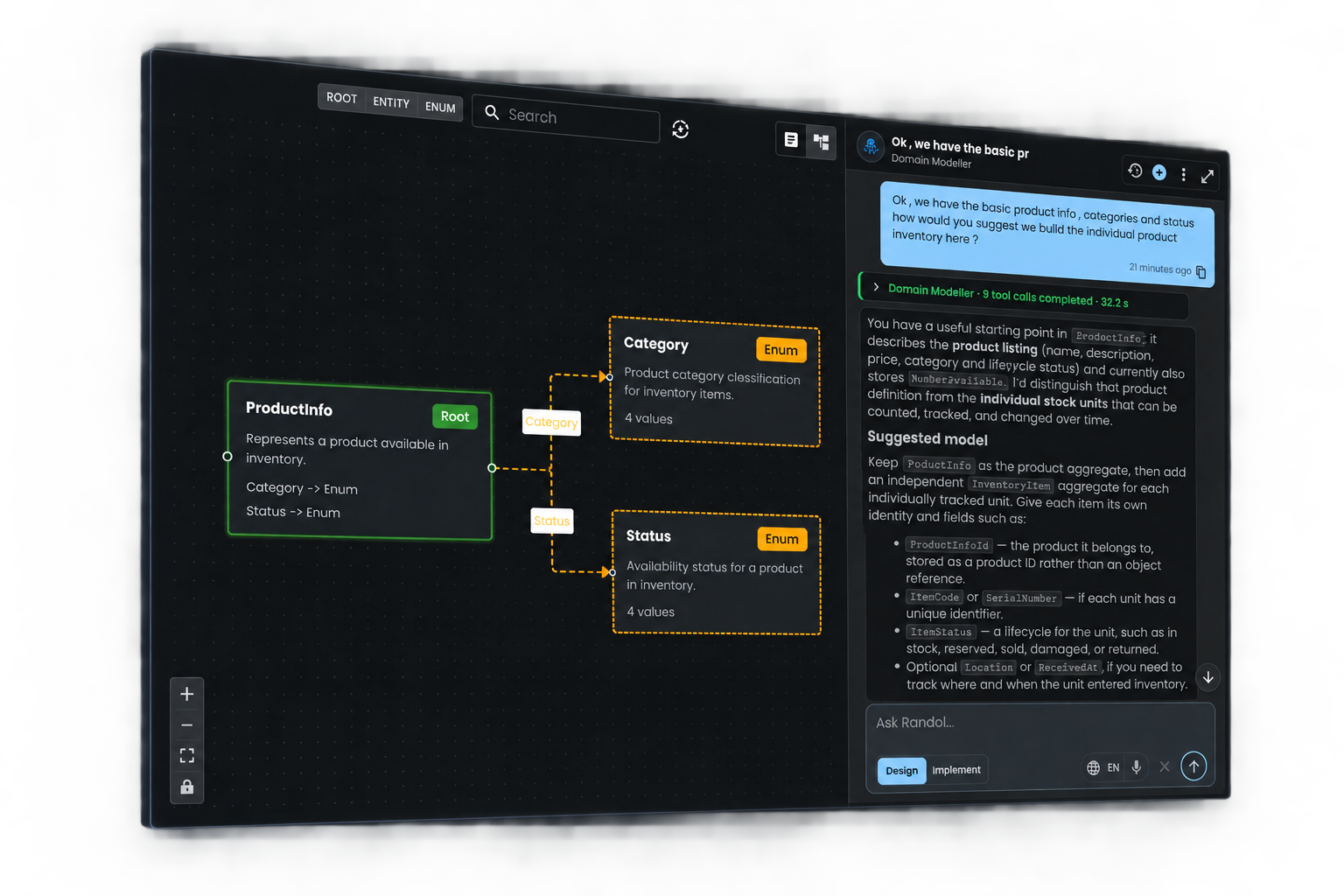
01 - Describe what you need
Start with the requirement. Define the information, rules, and actions your business needs, then iterate through conversation.
How It Works
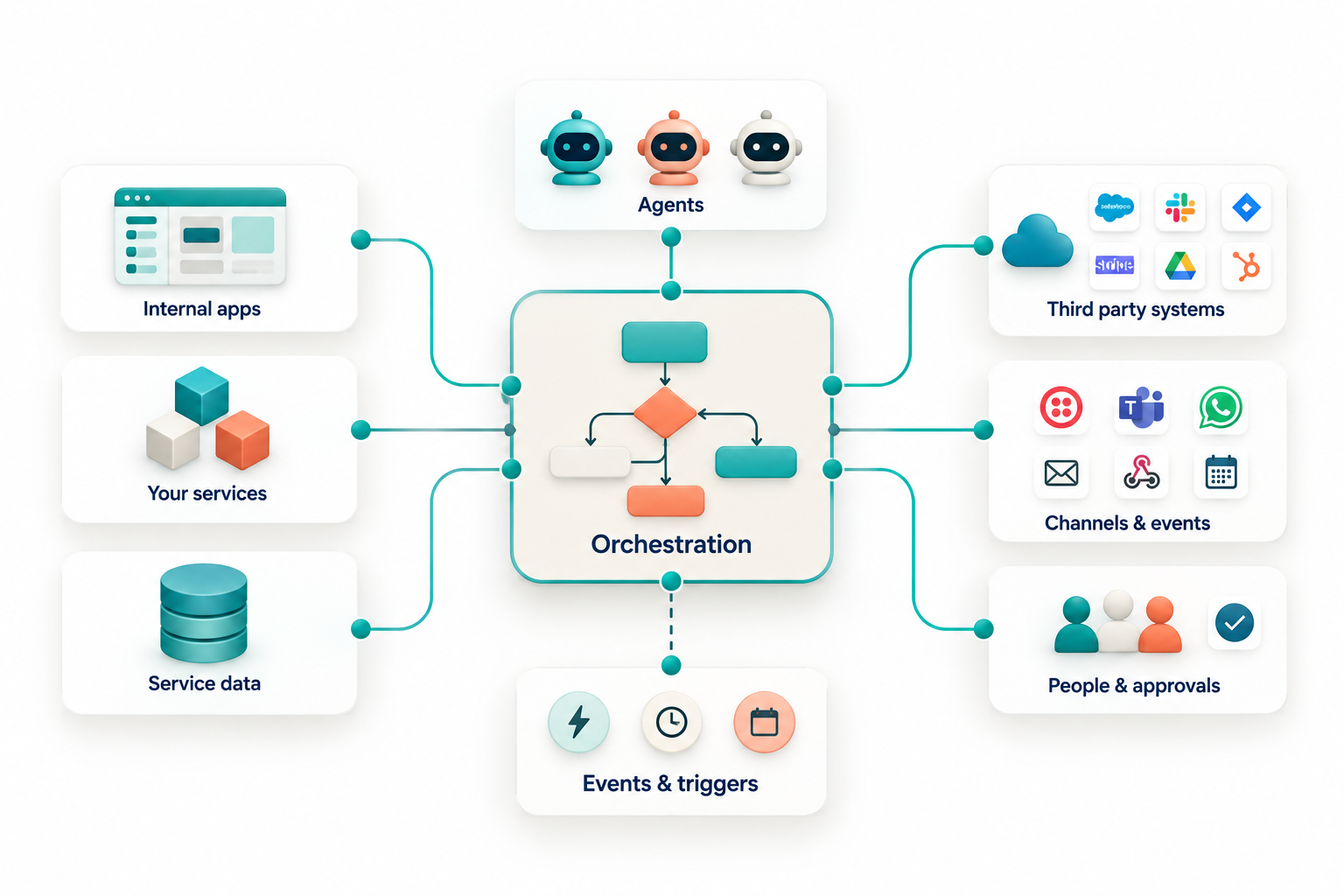
Randol combines Services, Orchestrations, and Applications so AI agents and people can act through the same governed enterprise capabilities.
This page expands each pillar with practical implementation detail, from reusable business services to orchestrated agent behavior and user-facing applications.
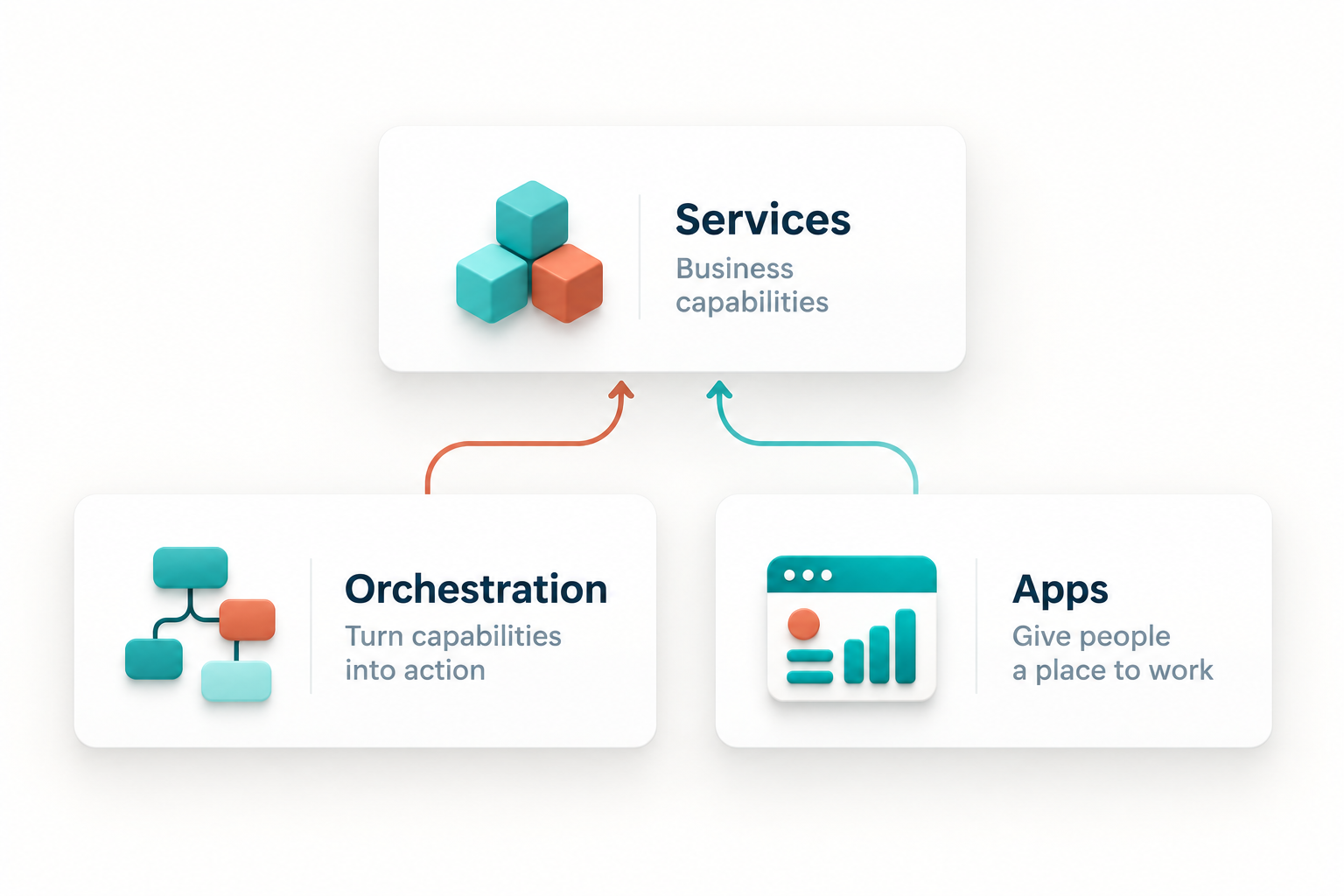
Services
Services in Randol, means tools and Skills for your agents. They hold the deterministic business logic, data ownership, and policy boundaries that keep outcomes reliable while agents operate with dynamic context.
At its simplest, a service brings together your business data, the rules that govern it, and the operations that allow people and systems to work with it.
It starts with your business data. Every service acts as a system of record for a particular area of your business. This means it takes responsibility for managing that information, keeping it accurate and controlling how it can be changed.
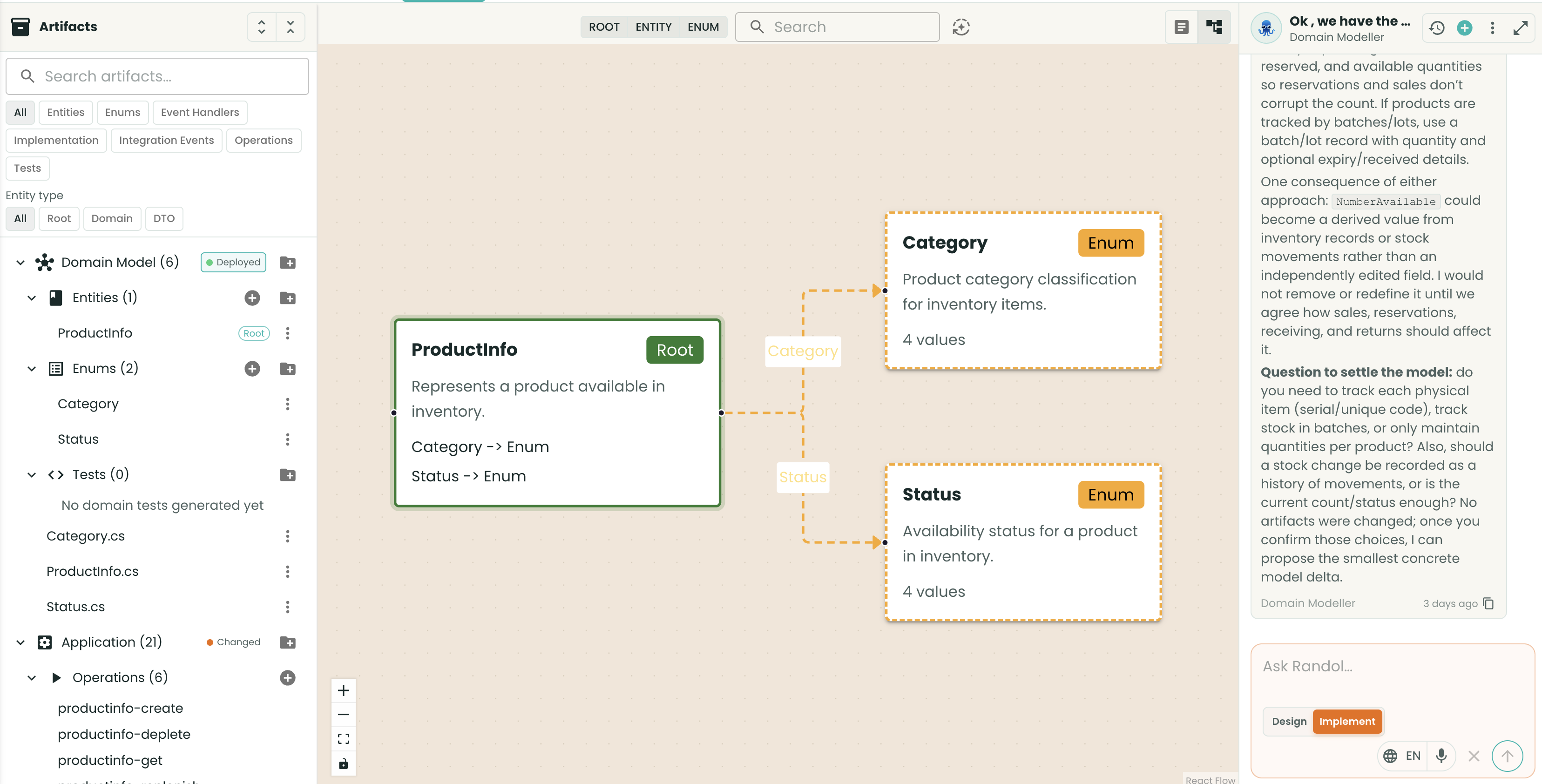
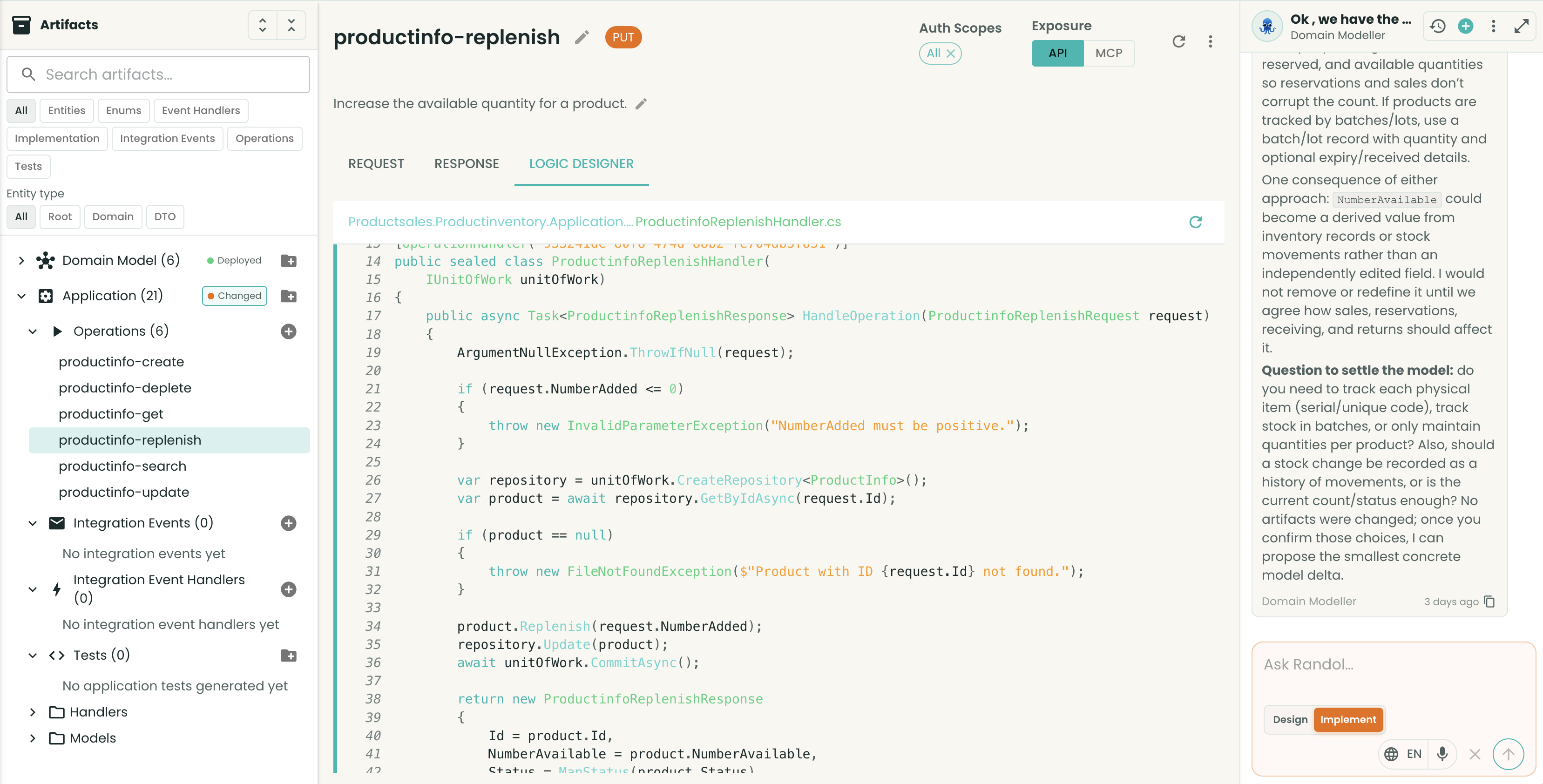
Inside the service is a domain model - a structured representation of something important to your business. For example, a Product service might manage product names, descriptions, prices and availability. The service becomes the trusted source for that information, rather than having different applications and agents maintain their own versions.
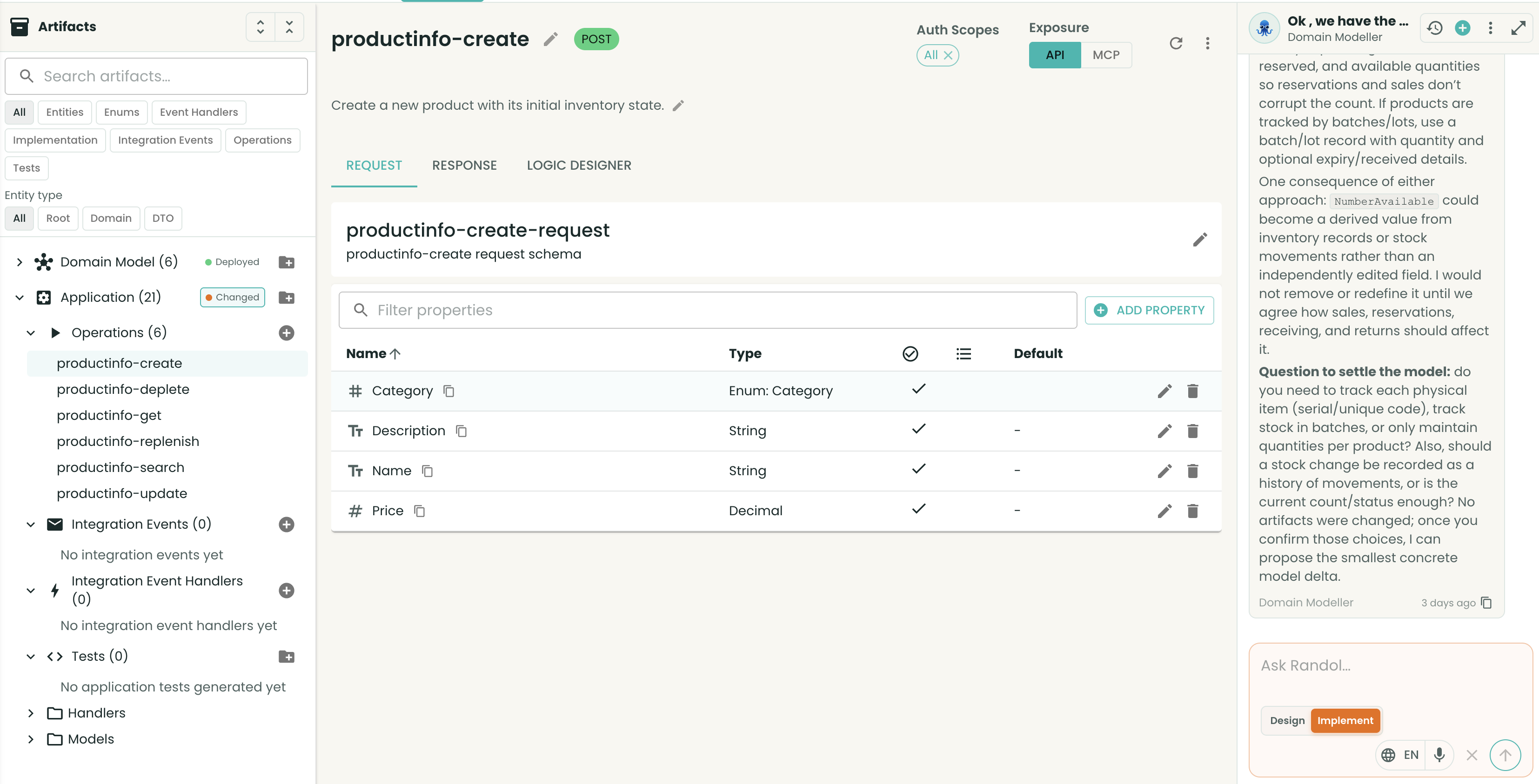
Next come operations. These are the actions a service makes available to the outside world. An operation might retrieve a product, create a new one, update its price or check its availability. Together, these operations form an API - a consistent way for applications, systems and intelligent agents to interact with your business capabilities.
Finally, there are your business rules. These define how operations behave and what is or isn't allowed. For example, changing a product's price might require approval, or a product might need to meet certain conditions before it can be made available for sale. These rules are enforced within the service, rather than being recreated by every application or agent that uses it.
This is what makes services so powerful. Your business capabilities become reusable building blocks that can be accessed by websites, mobile apps, employees, AI agents, partners and external systems.
And because the service remains the system of record, every interaction works with the same trusted information and follows the same business rules, regardless of how or where it originates.
As organisations introduce more intelligent agents, this becomes increasingly important. Agents can interpret requests, make contextual decisions and coordinate activities, while services provide the trusted data, controlled operations and business rules that turn those decisions into reliable actions.
One trusted business capability. Available wherever you need it.
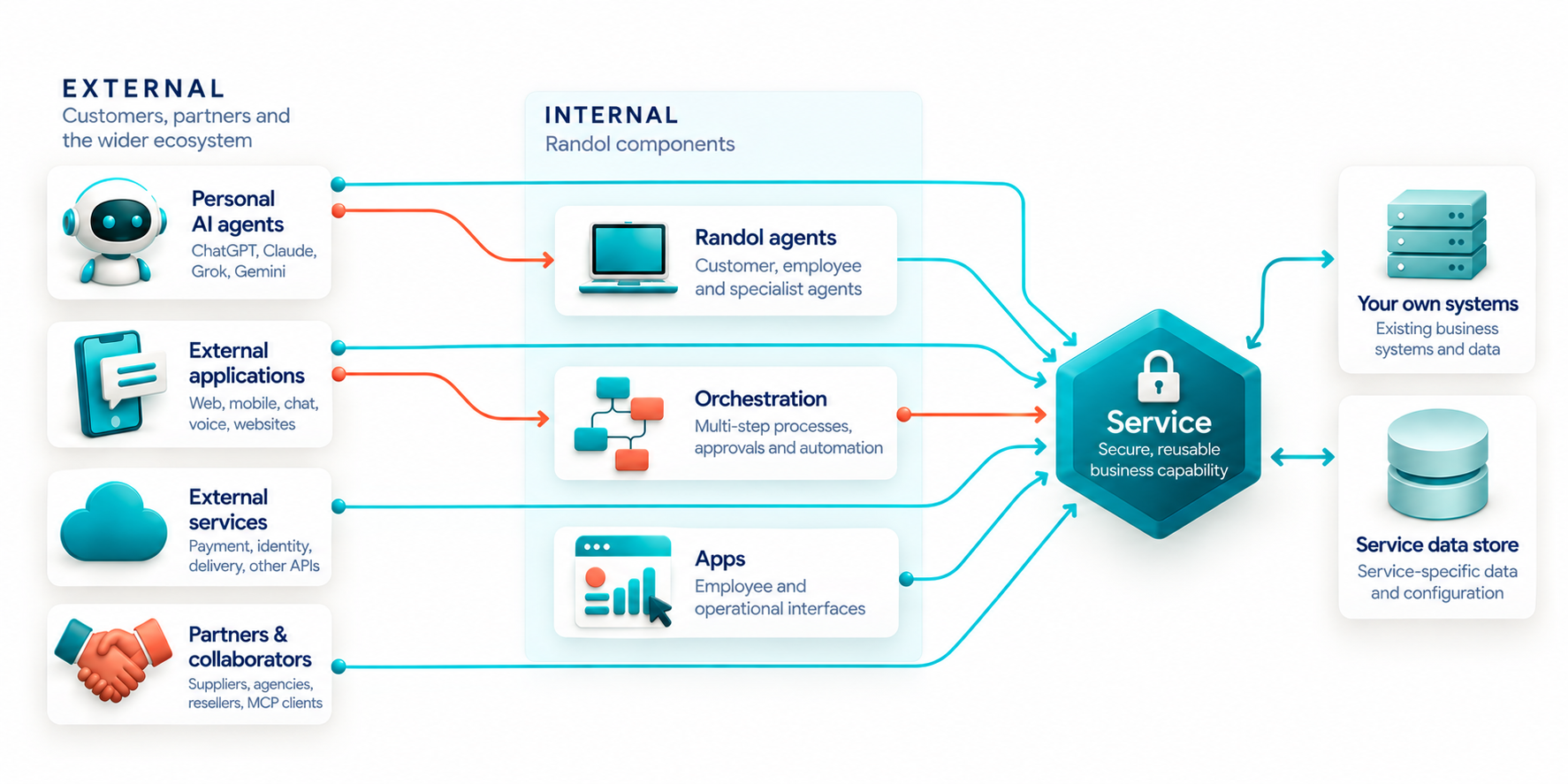
Everything depends on strong services: reusable operations, consistent business rules, and secure interfaces that different channels can trust.

Building new services in Randol is simple, quick, and reliable. The conversation experience lets you work with, iterate, and build services that once needed a dedicated expert microservices team.
Start with the requirement. Define the information, rules, and actions your business needs, then iterate through conversation.
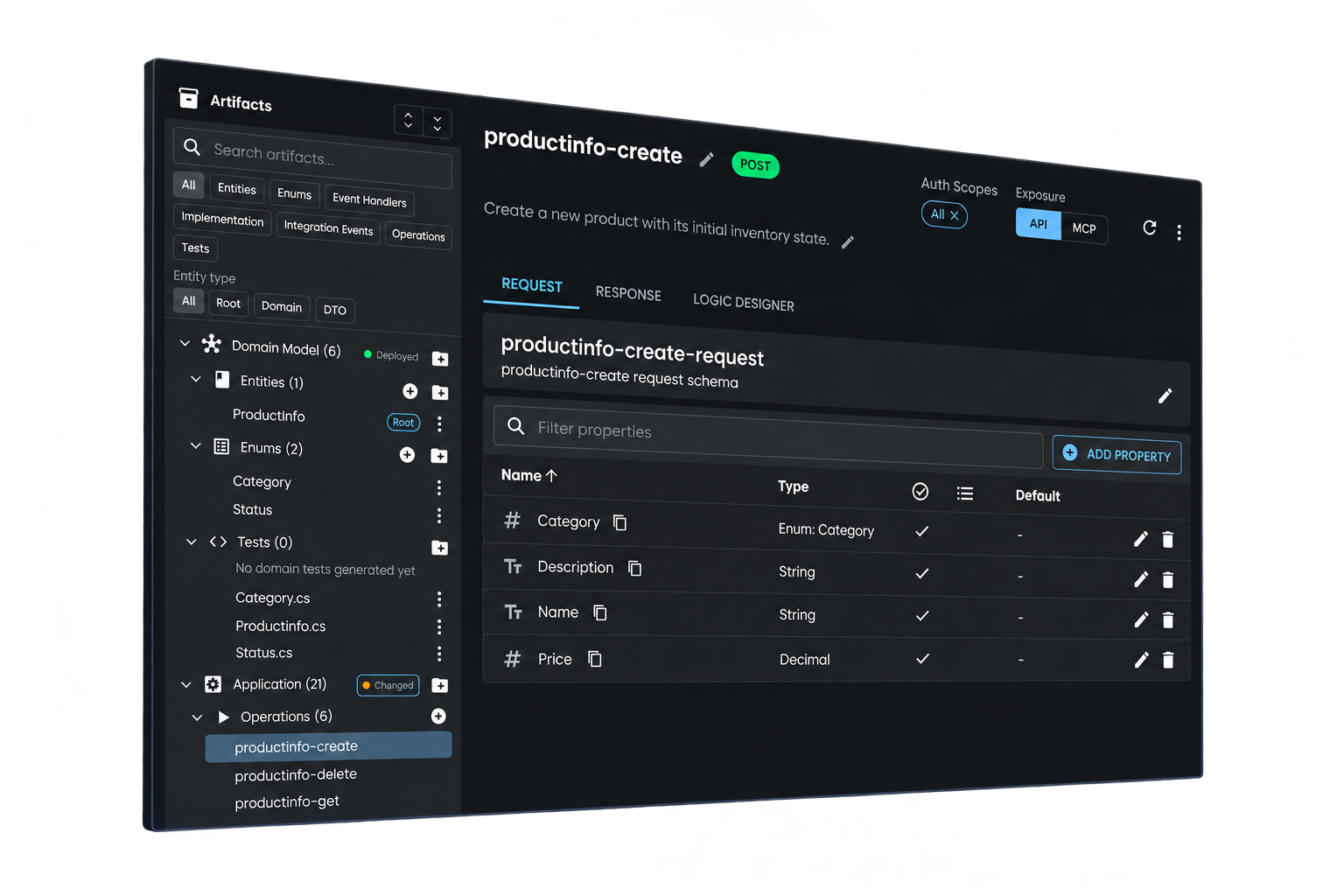
Generate and deploy a service with its own data structures, logic, and operations that can run independently at enterprise scale.

Expose the capability to orchestrations, applications, APIs, MCP tools, agents, copilots, and partners from one governed platform.
Orchestrations
Orchestration is a powerful pillar within Randol.
Orchestration is where your business capabilities, systems and intelligent agents come together to get things done.
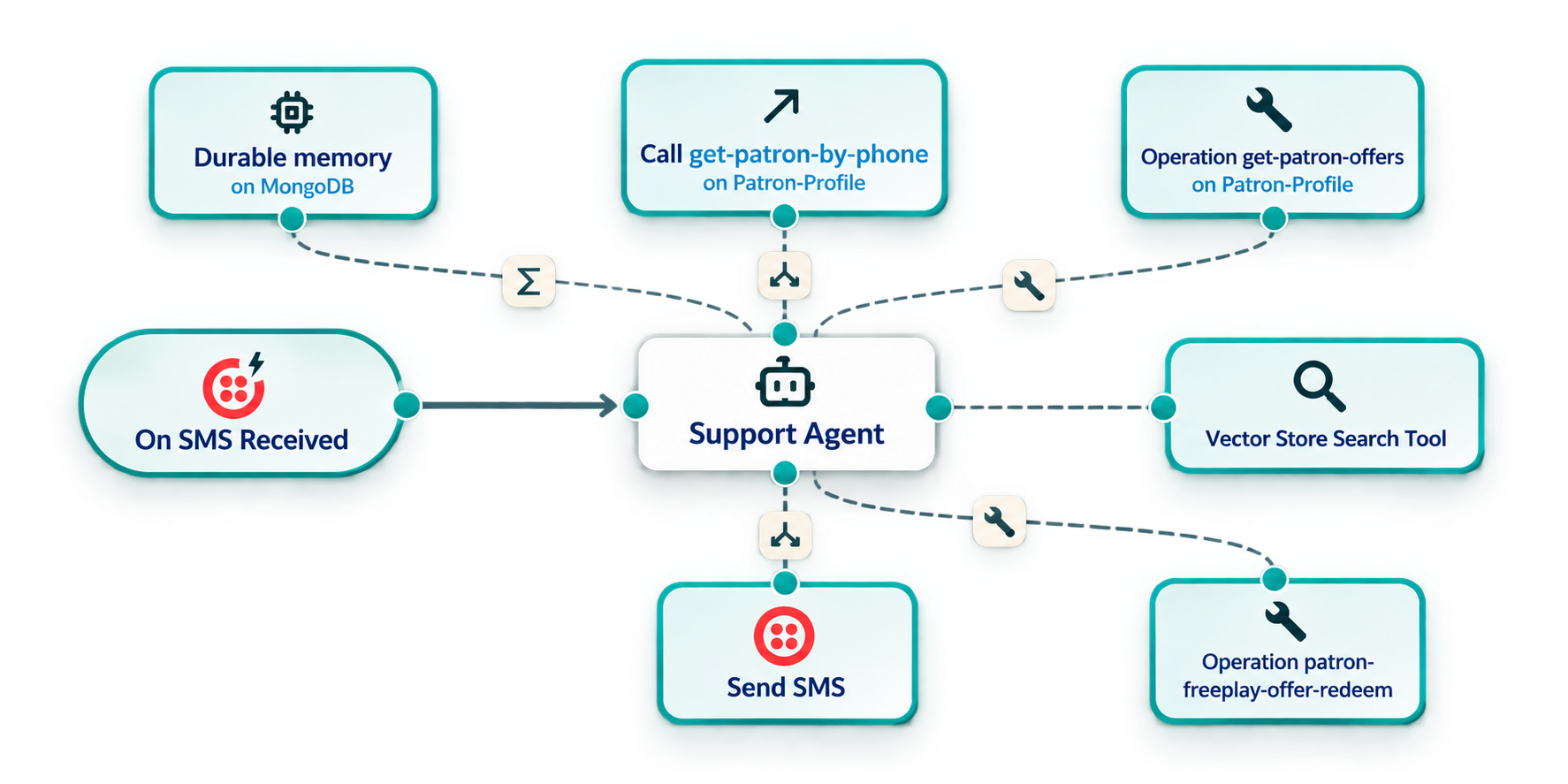
Whether you're automating a simple task, coordinating a complex business process or building a network of intelligent agents, Randol provides a flexible environment to design how everything works together.
At its core, every orchestration is built from three simple elements: Triggers, Activities and Transitions.
Every orchestration begins with an entry point, an event or action that tells Randol it's time to do something. These are called trigger activities.
That could be a customer sending a text message, a new message appearing in Microsoft Teams, an incoming email, a conversation through a Randol application or a webhook from another system.
Or it could be something as simple as a scheduled time, such as running a report every Monday morning.
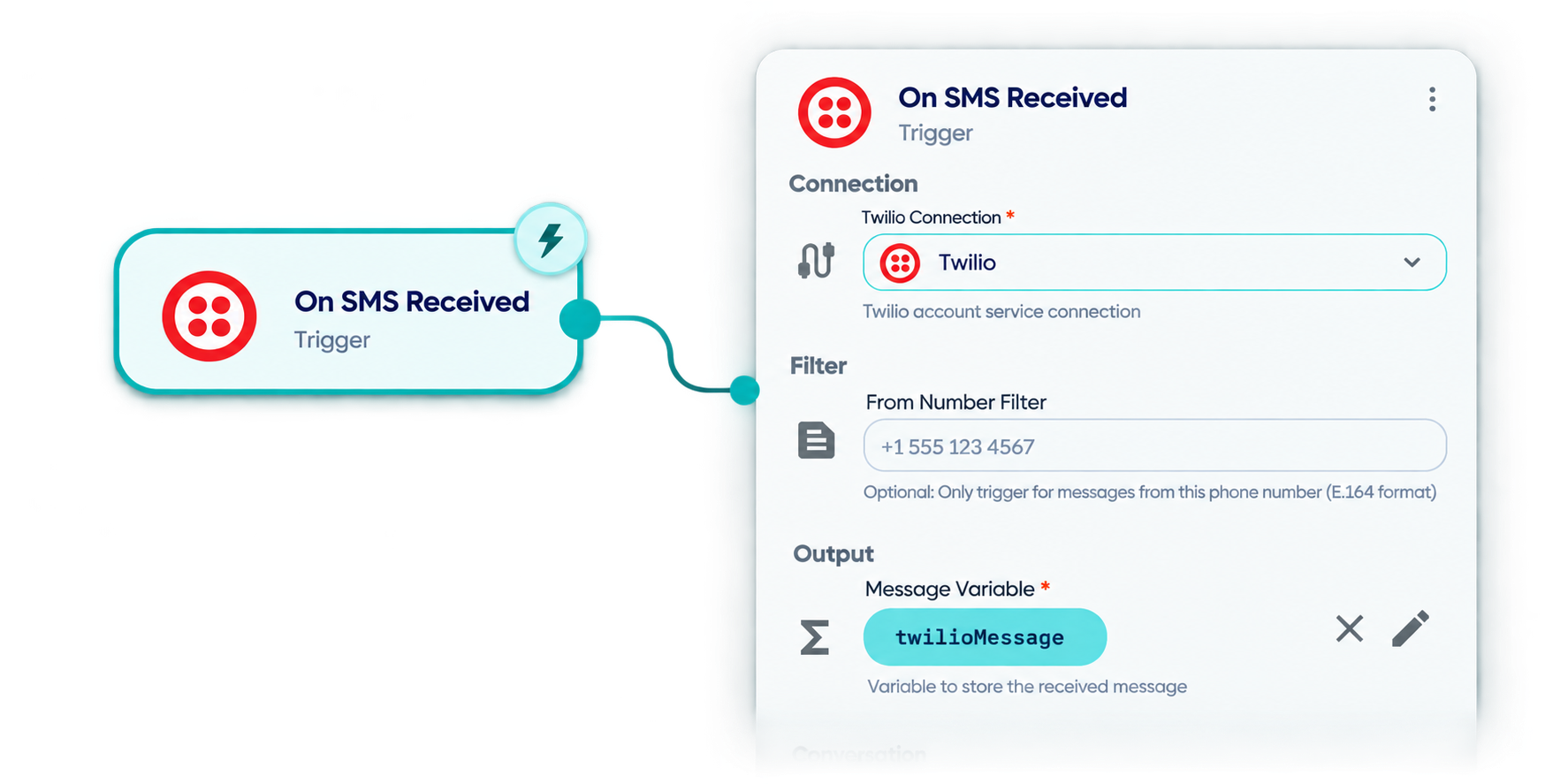
However the request arrives, triggers get things moving.
Activities are the building blocks of your orchestration. Each activity performs a task, and you can combine as many as you need to create anything from a simple automation to a sophisticated intelligent workflow.
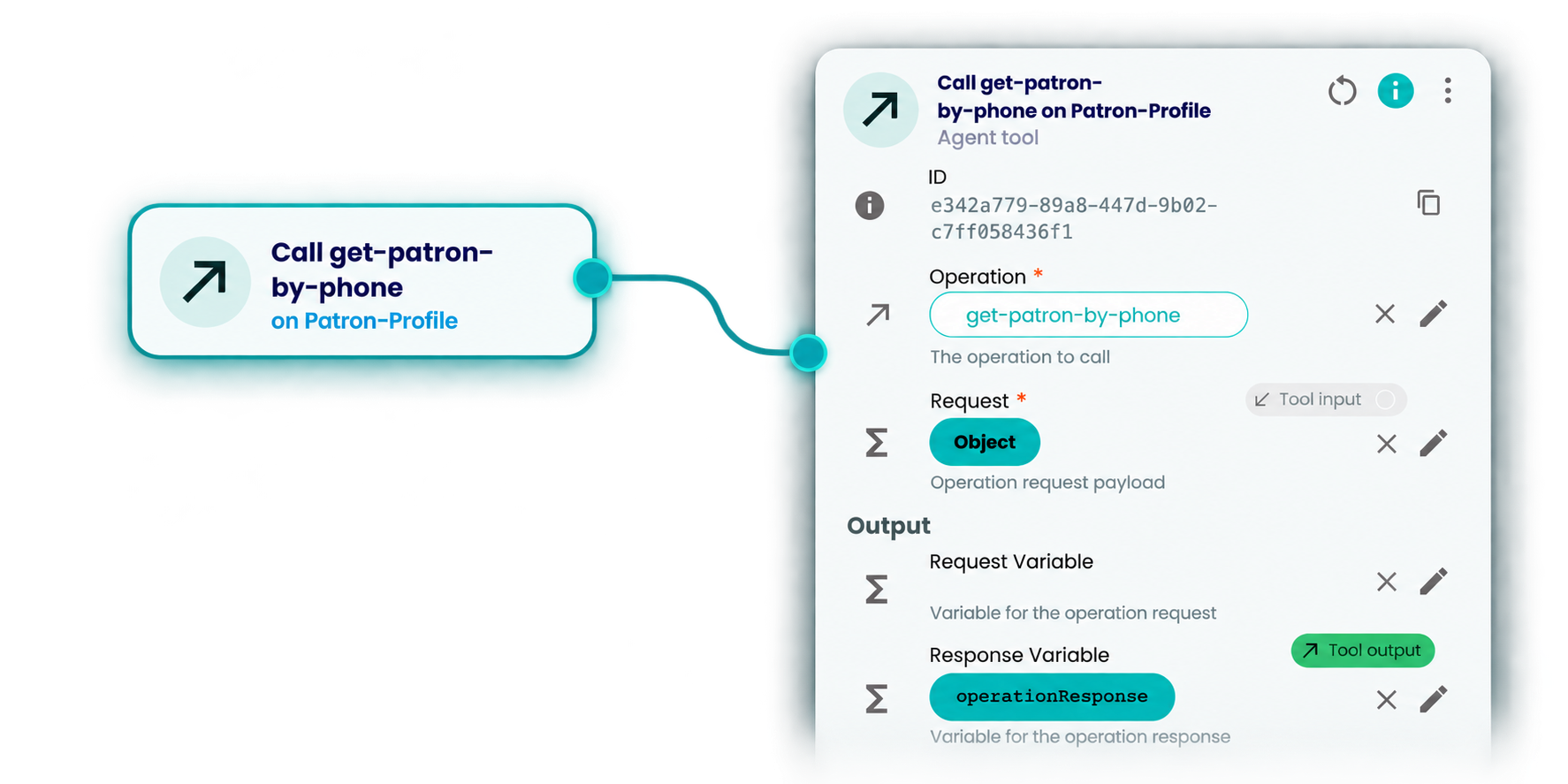
Activities can call your Randol services to retrieve or update business information, connect to existing internal systems, or interact with third-party platforms such as Stripe for payments or Slack for messaging.
They can also introduce intelligence into your processes.
Agent activities allow you to configure individual AI agents or connect multiple agents to work together. Give them access to tools, including your Randol service operations, external APIs and third-party integrations, so they can understand requests, reason, make decisions and take meaningful action.
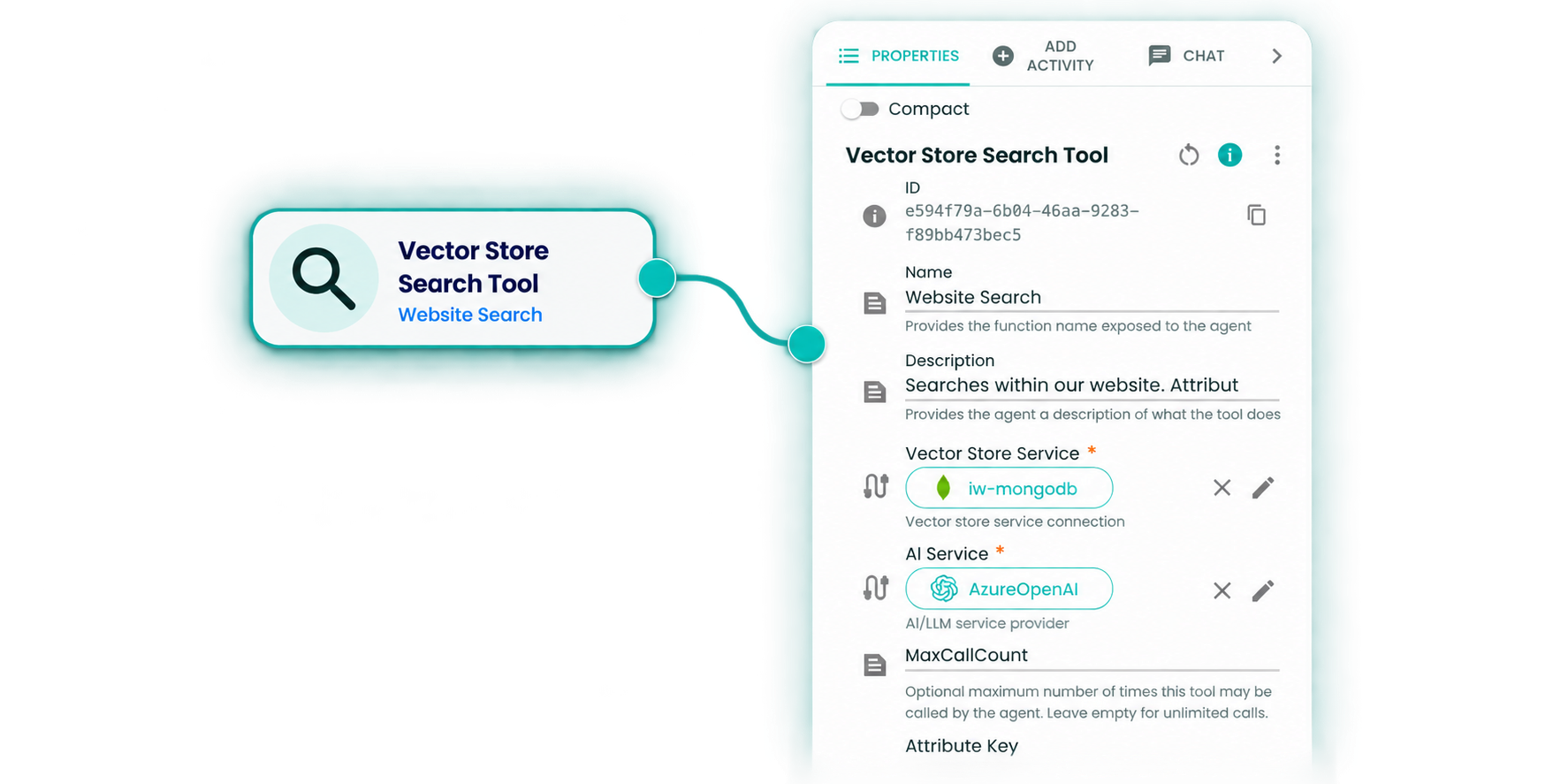
Data and document activities let you process information, extract structured data, and turn documents into searchable knowledge using vector stores and indexing. This opens the door to research assistants, intelligent document processing and knowledge-driven agents.
With hundreds of activities available, and new capabilities added regularly, you can build increasingly sophisticated solutions without recreating the underlying integrations and functionality.
Transitions connect your activities and determine how work moves through an orchestration.
Sometimes the next step is straightforward. Other times, you need to make a decision.
Transitions can evaluate conditions and direct the process down different paths based on business rules, data or the results of previous activities.
For example, a payment might proceed only when a customer has sufficient credit, or a request might be routed for human approval when certain conditions are met.
This gives you control over how processes progress, while still allowing intelligent agents to operate where flexibility and contextual decision-making are needed.
Not every decision should be left to AI. And not every business process can be reduced to a fixed set of rules.
Randol lets you decide where deterministic logic ends and agent intelligence begins.
Some activities need to be predictable and consistent. Checking a customer's balance, enforcing payment limits, calculating a price or updating a business record should follow clearly defined rules.
Other activities benefit from interpretation and reasoning. Understanding a customer's intent, analysing an unfamiliar document, researching information or deciding how best to respond to a complex request are areas where intelligent agents can add real value.
With Randol, you can bring both approaches together within the same orchestration.
Use defined activities, business rules and conditional transitions where outcomes must be controlled. Introduce agents where understanding, flexibility and contextual decision-making are needed. And connect agents to your governed services so that the actions they take remain within the boundaries you've established.
You decide what must happen, what can be decided intelligently, and where human approval is required.
This is how Randol bridges the gap between the reliability of traditional business systems and the possibilities of agentic AI.
Randol's orchestration environment gives you the flexibility to design and configure processes visually, connecting triggers, activities and transitions into powerful workflows.
Or you can work conversationally with Randol, describing what you want to achieve and using AI to help build your orchestration.
From simple automations to sophisticated multi-agent solutions, you have the freedom to combine predictable business processes with intelligent decision-making.
One environment to connect your systems, coordinate your agents and turn business capabilities into action.
Applications
Even in a world of intelligent agents and automated processes, there are times when people need more than a conversation. They need somewhere to see what is happening, understand the current state of their business, review information and take action.
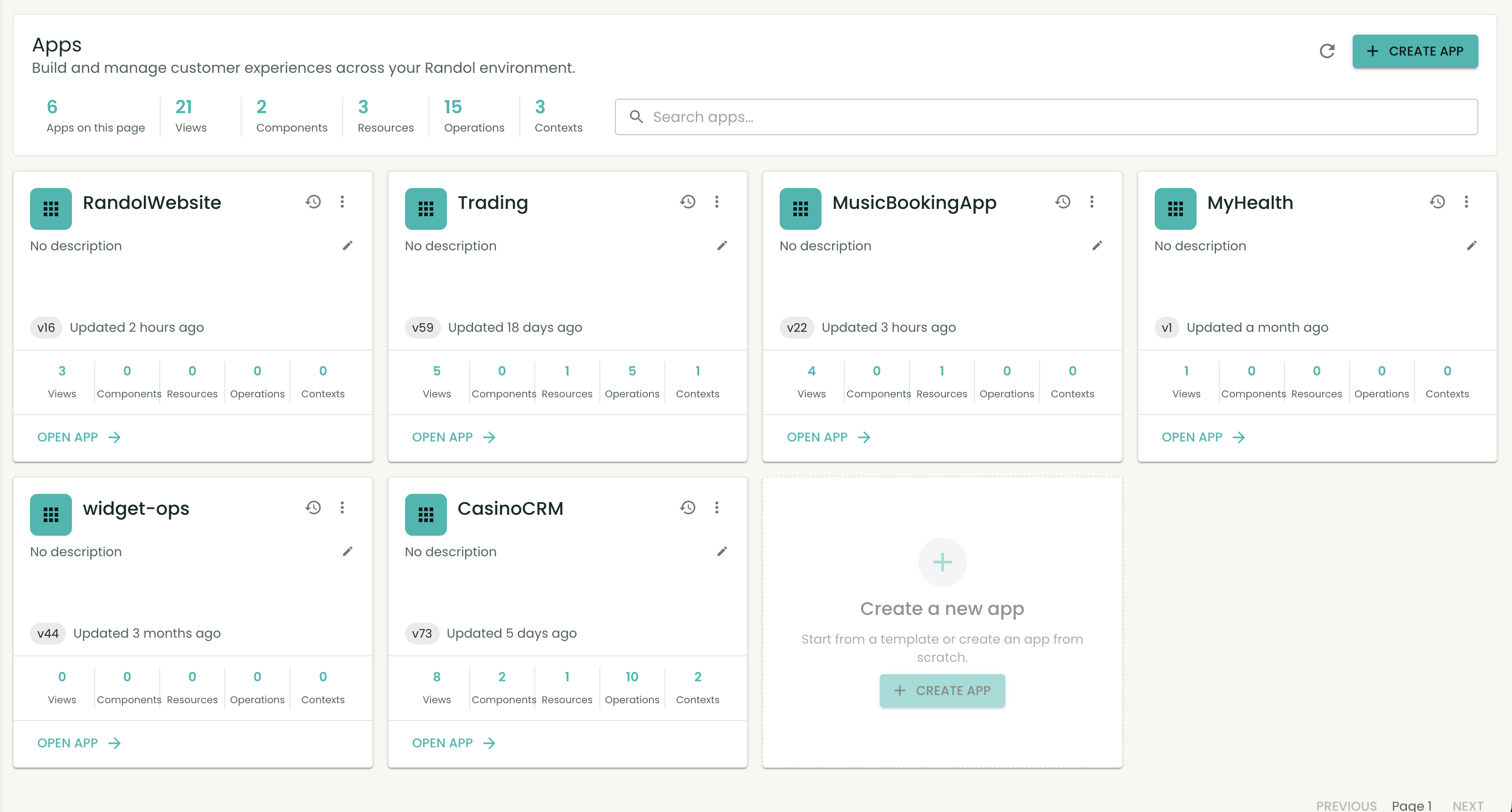
Randol Apps let you build and deploy fully functional React applications, using the services, business logic and platform capabilities you have already created in Randol.
From complete business applications to small embedded interfaces and rich conversational experiences, Apps provide the human-facing part of your connected solutions.
Intelligent agents are changing how we interact with business systems. Instead of navigating multiple screens, people can increasingly ask agents to find information, complete tasks and coordinate activities on their behalf.
But not everything should happen through a conversation, and not every decision should be automated.
Consider a customer onboarding process. An orchestration might receive an application, extract the relevant information, validate documents and perform background checks using intelligent agents.
But before a new customer is approved, your organisation may need someone to review the information, resolve exceptions or provide formal approval.
In regulated environments, that might mean a four-eyes or six-eyes approval process, where multiple people must independently review and authorise a decision.
This is where Apps become essential.
Randol provides the interface for people to participate in these processes, review information and make decisions, while the underlying services and orchestrations continue to manage the business logic and workflow.
Not every interaction requires a complete application. Randol gives you the flexibility to create experiences that fit the situation.
Full business applications
Build complete React applications with navigation, multiple screens, role-based access, search, data management, forms, dashboards and operational workflows.
Whether it is a customer management system, an internal operations portal or a specialist business application, you can build on your existing Randol services without duplicating the underlying business logic.
Embedded interfaces and focused experiences
Sometimes all you need is a small interface that fits into an existing experience.
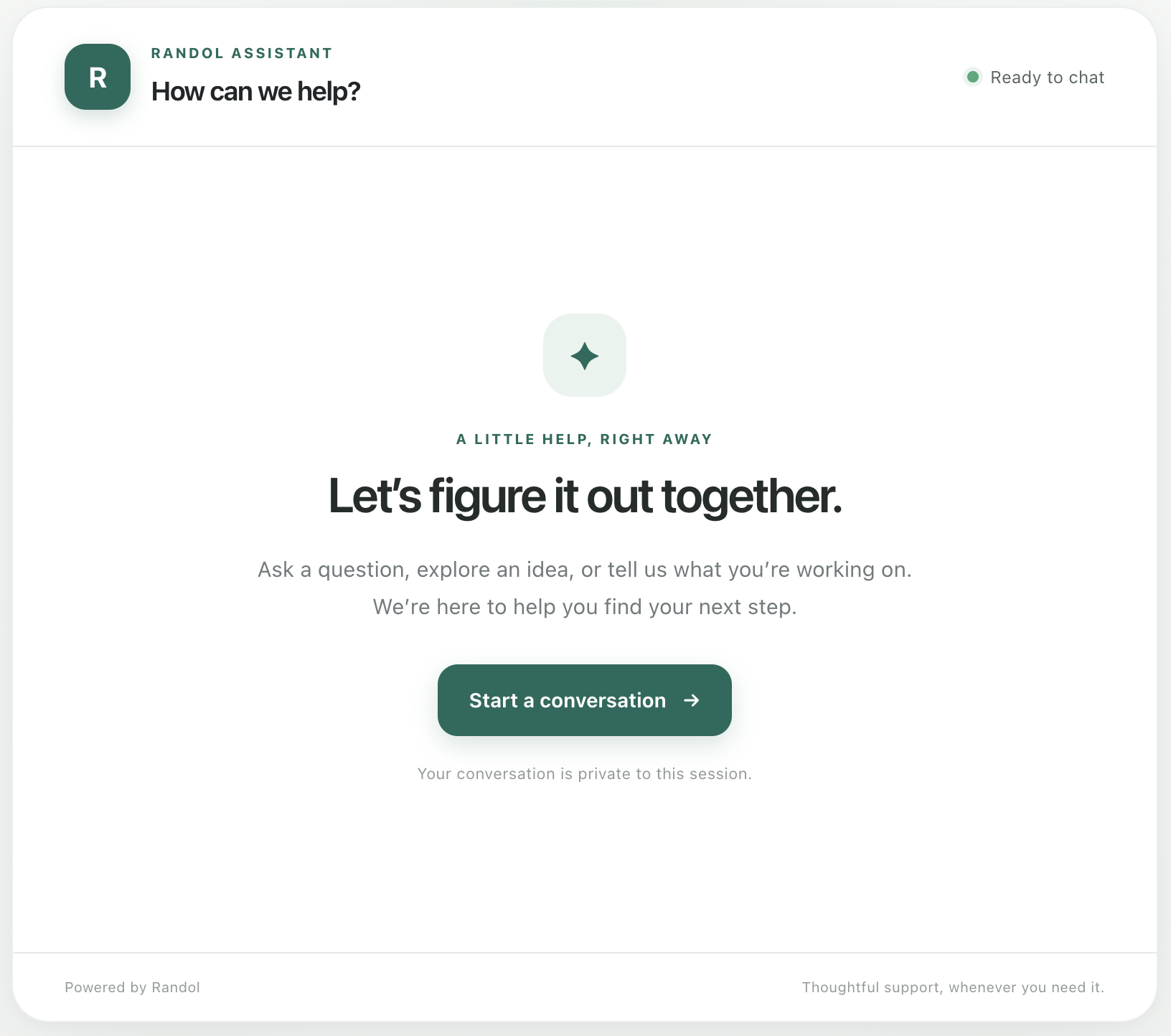
Create a customer enquiry form, a data-entry screen, an approval interface or a chatbot embedded within your website. Give people exactly the functionality they need, without introducing another large application.
Rich conversational experiences
Conversations do not have to be limited to text.
Build intelligent chat experiences that combine natural language responses with interactive components such as forms, tables, cards and other visual widgets.
An agent might answer a question, display relevant business information in a structured view, ask the user to complete a form or present options for a decision, all within the same conversation.
This combines the flexibility of conversational AI with the clarity and usability of traditional interfaces.
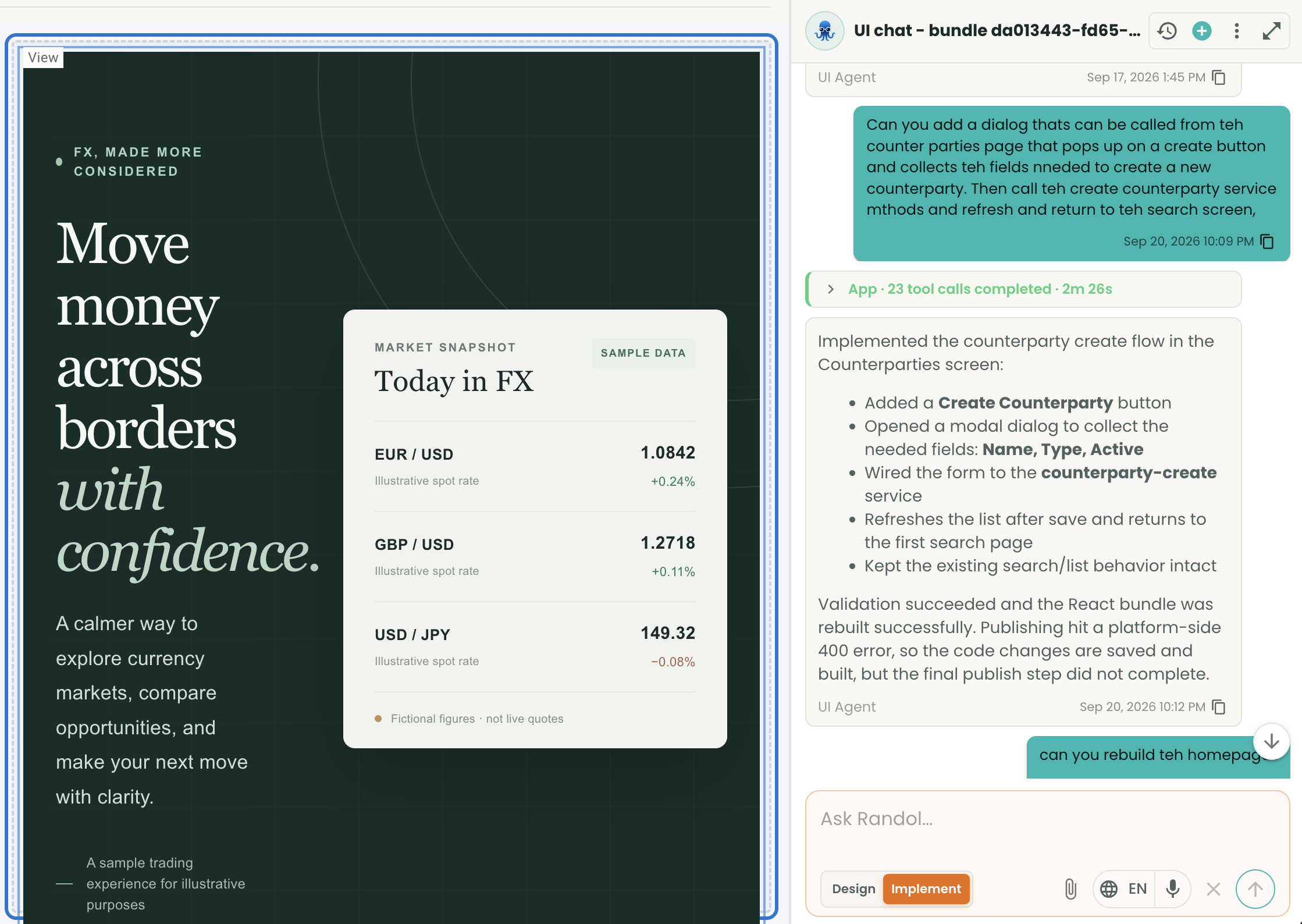
Randol also supports a vibe-code style of app creation, where you can describe what you need in chat, quickly visualise the experience, and iterate in real time with your team.
This makes it easy to move from idea to working interface, explore your data in context, and refine behavior without slowing down delivery.
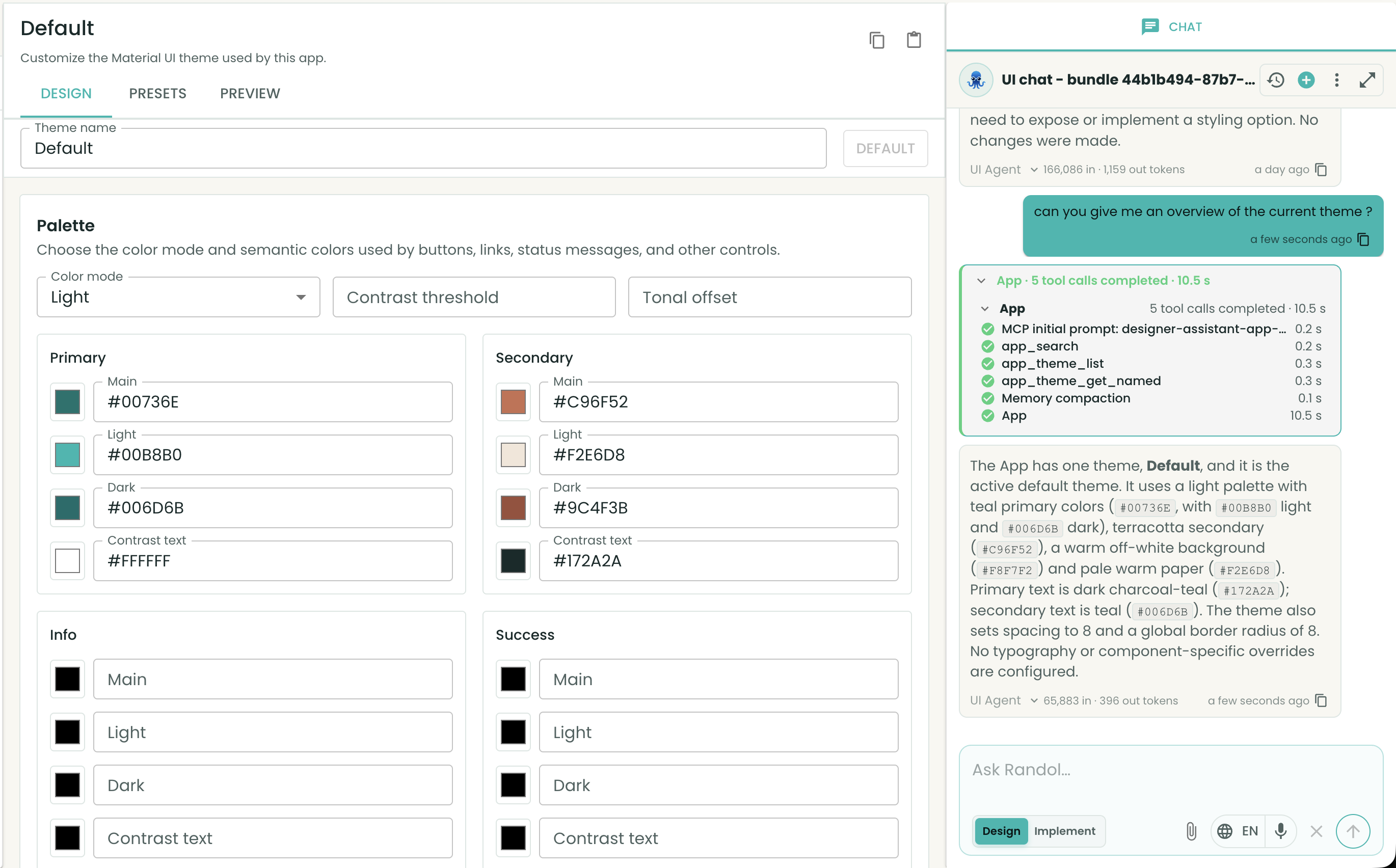
You can fully customise branding, styling and application behaviour so each experience matches your business identity and operational needs.
Randol Apps do not require you to rebuild the business capabilities you have already created.
Connect directly to your Randol services to retrieve and update information, use platform components and security capabilities, and interact with orchestrations to initiate or progress business processes.
The application provides the experience. Your services remain the systems of record, and your orchestrations coordinate the work.
This means the same business capability can be accessed through a full application, an embedded interface, a conversational agent or an external system, without duplicating the rules behind it.
Whether you are building a single approval screen or a complete enterprise application, Randol provides a consistent approach to building and deploying the interfaces your business needs.
Because the future is not just agents replacing applications. It is agents, applications and orchestrations working together.
Connections
Your organisation already has systems, data, applications and technology platforms that are essential to how it operates. Randol brings them together, making their capabilities accessible to your services, orchestrations, applications and intelligent agents.
Whether you are connecting to an internal business system, a cloud provider, an AI model or a third-party platform, Randol provides a consistent way to configure, secure and reuse those connections.
Connections provide the foundation for interacting with external systems and services.
Rather than configuring access separately for every application, agent or business process, Randol lets you establish connections centrally and reuse them wherever they are needed.
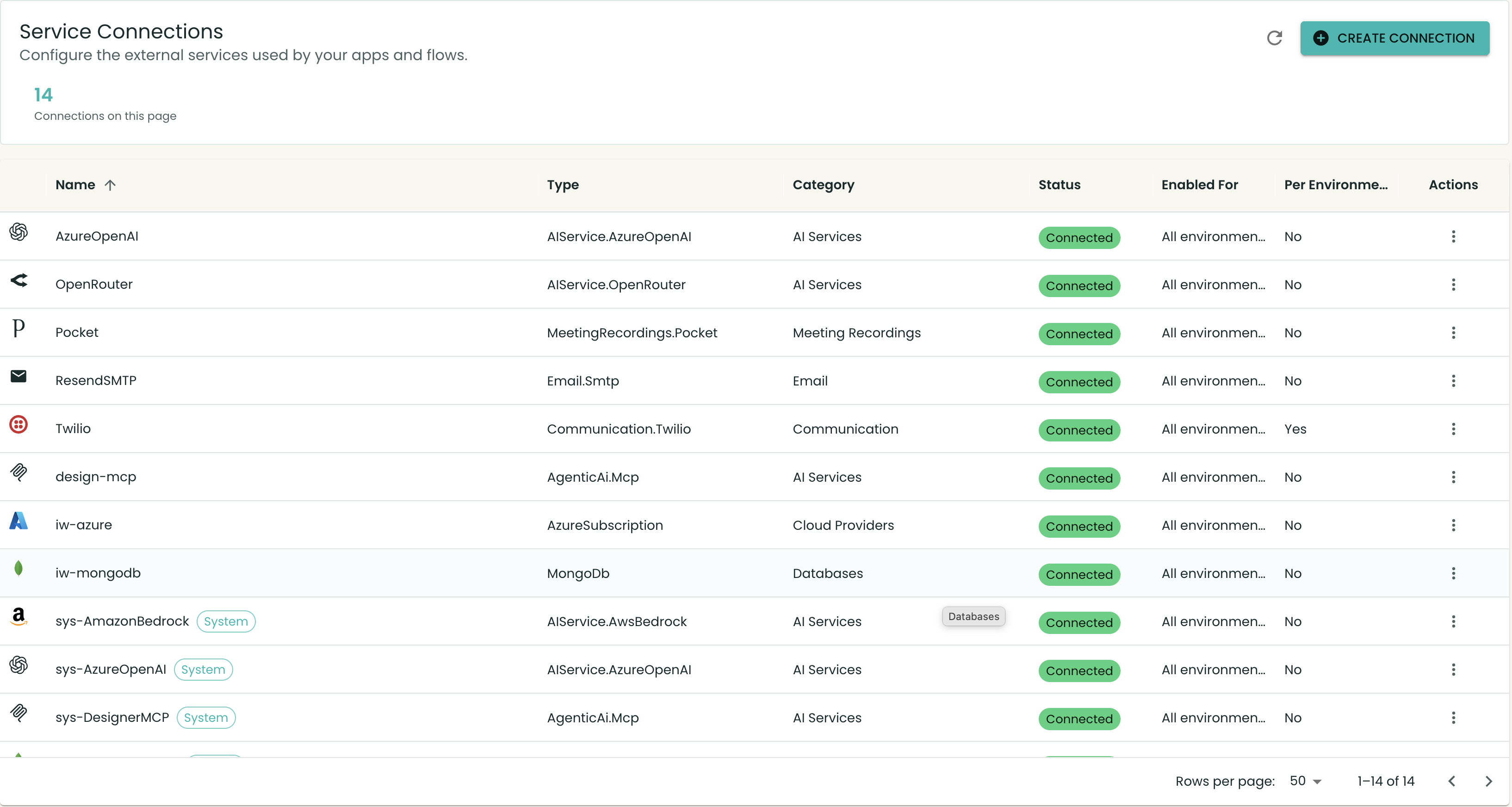
A connection might provide access to a Microsoft Teams workspace, a Stripe payment account, a cloud storage service, an AI model provider or one of your existing internal business systems.
Once configured, these connections can be used by activities in your orchestrations, support your services and provide intelligent agents with access to tools and external capabilities.
Connect your technology once, then bring its capabilities into the solutions you build.
Randol Connections are not tied to a single application, orchestration or deployment environment.
You can reuse the same connection across multiple solutions and environments, or configure different connections for development, staging and production without changing how your services and orchestrations work.
For example, you might use one CRM instance for testing and another for production. Or choose one cloud provider for development and a completely different provider for your production environment.
The same flexibility applies to AI models, databases, messaging platforms and other connected technologies.
Your solutions remain consistent, while the systems and providers behind them can change between environments.
This gives your organisation greater control over testing, deployment and infrastructure choices without having to rebuild business processes or duplicate integrations for each environment.
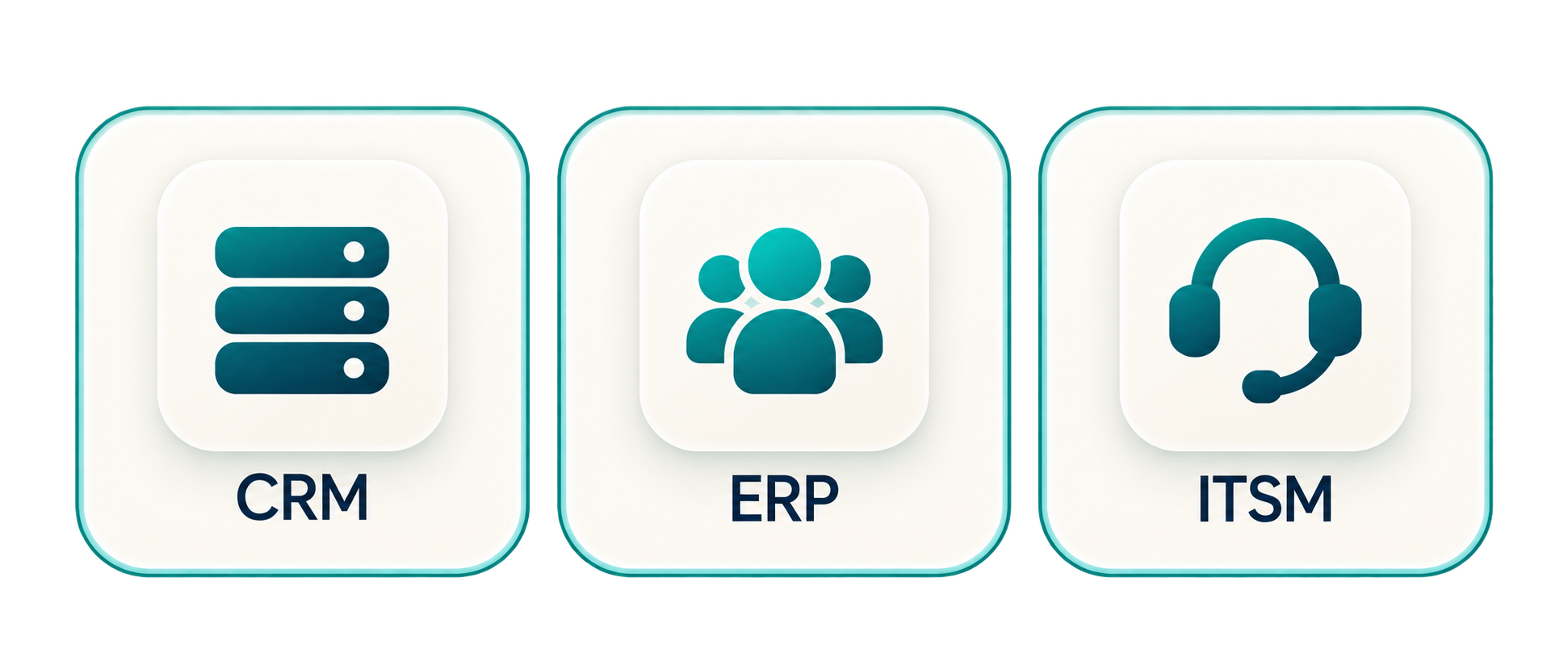
Connect Randol to the systems that already run your organisation, including CRM, ERP, operational platforms and your own internal APIs.
Bring existing business information and functionality into new applications, automated processes and agent-driven experiences without replacing the systems you already depend on.
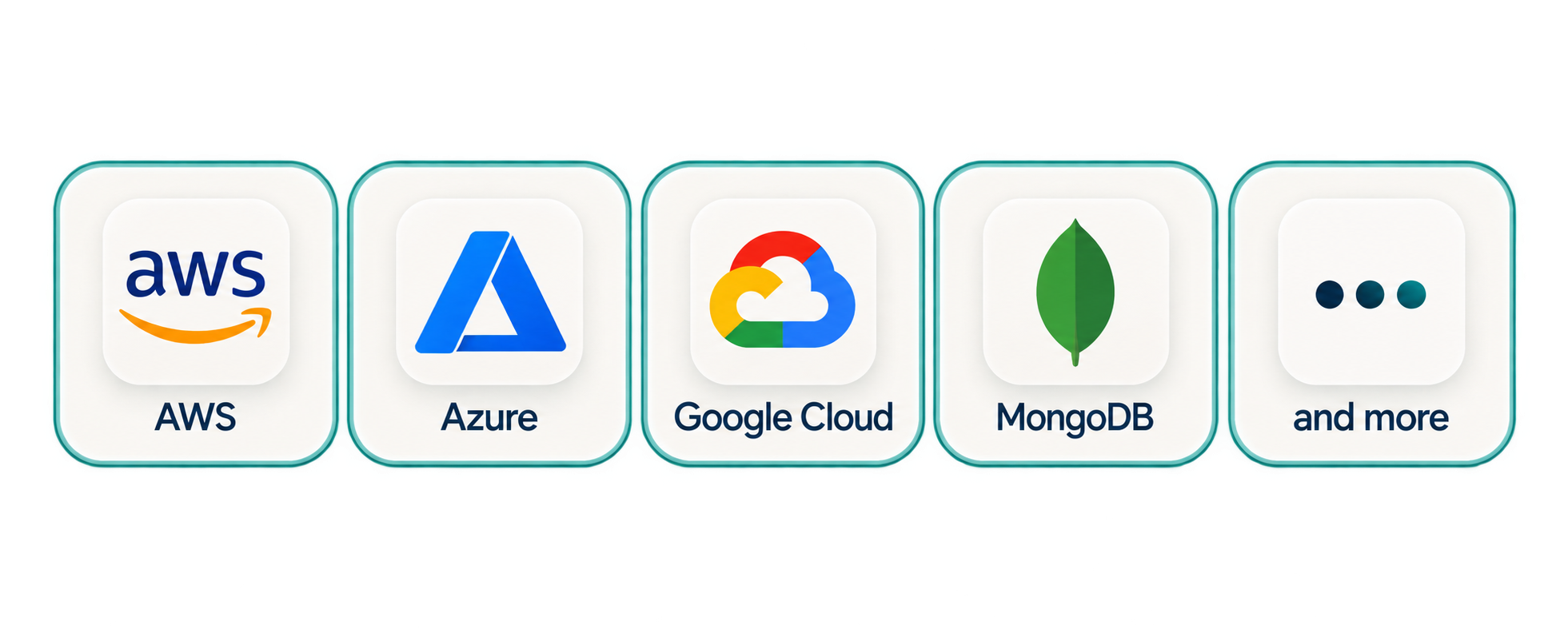
Connect to the cloud technologies that support your solutions, including data platforms, document storage, messaging infrastructure and other managed services.
Use the infrastructure and providers that make sense for your organisation, with the flexibility to configure different technologies across your environments.
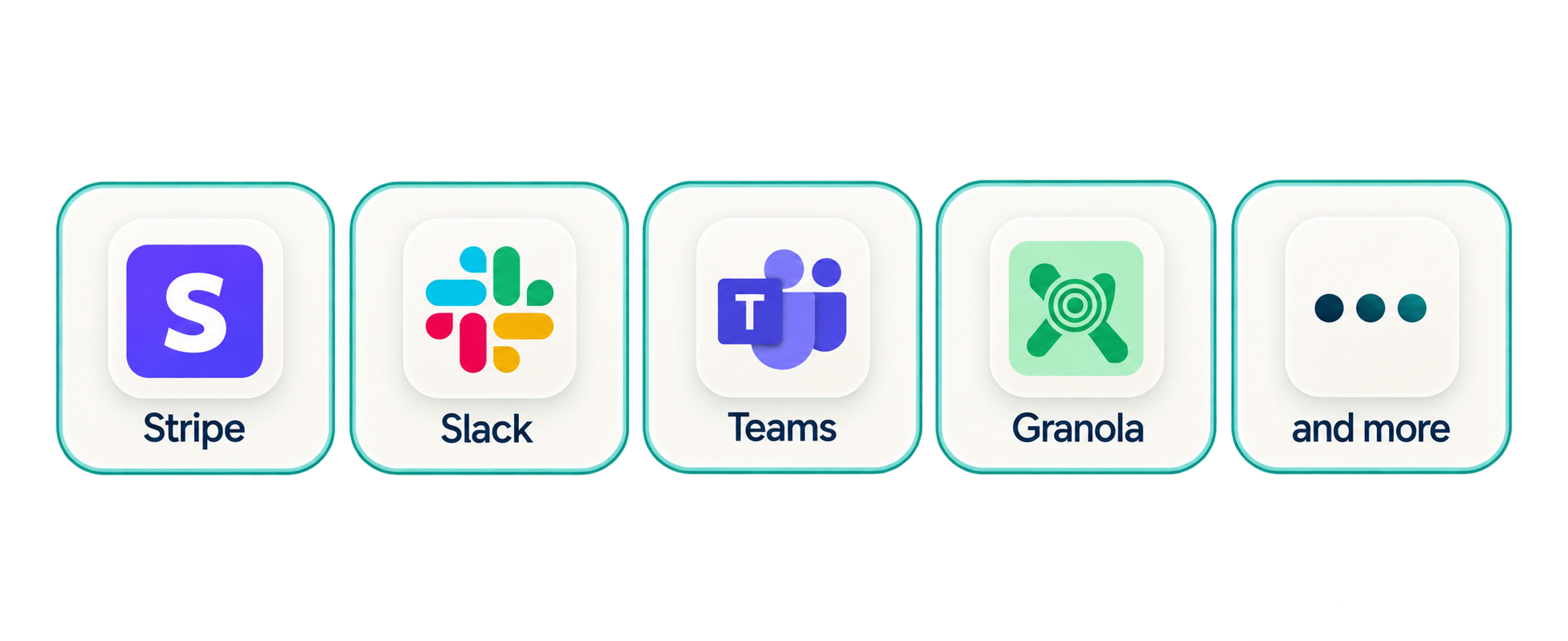
Extend your solutions with the technologies your business already uses.
Connect to communication platforms such as Slack and Microsoft Teams, payment providers such as Stripe, document services, AI models and a growing ecosystem of third-party tools.
Randol provides a consistent way to incorporate these capabilities into your orchestrations, regardless of the underlying provider.
Connecting systems becomes especially powerful when those capabilities are made available to intelligent agents.
An agent can do more than answer questions based on the information it has been given. Through Randol, it can access approved tools to retrieve information, initiate business operations, interact with third-party platforms and participate in real business processes.
For example, a customer service agent might retrieve information from your CRM, check an account balance through a Randol service, initiate a payment through Stripe and send a confirmation through a messaging provider.
All within a governed orchestration, using the connections and capabilities you have already established.
Your agents gain access to real business capabilities, while you retain control over the systems and operations they can use.
Randol provides a growing library of supported connections and activities, with new technologies and providers being added regularly.
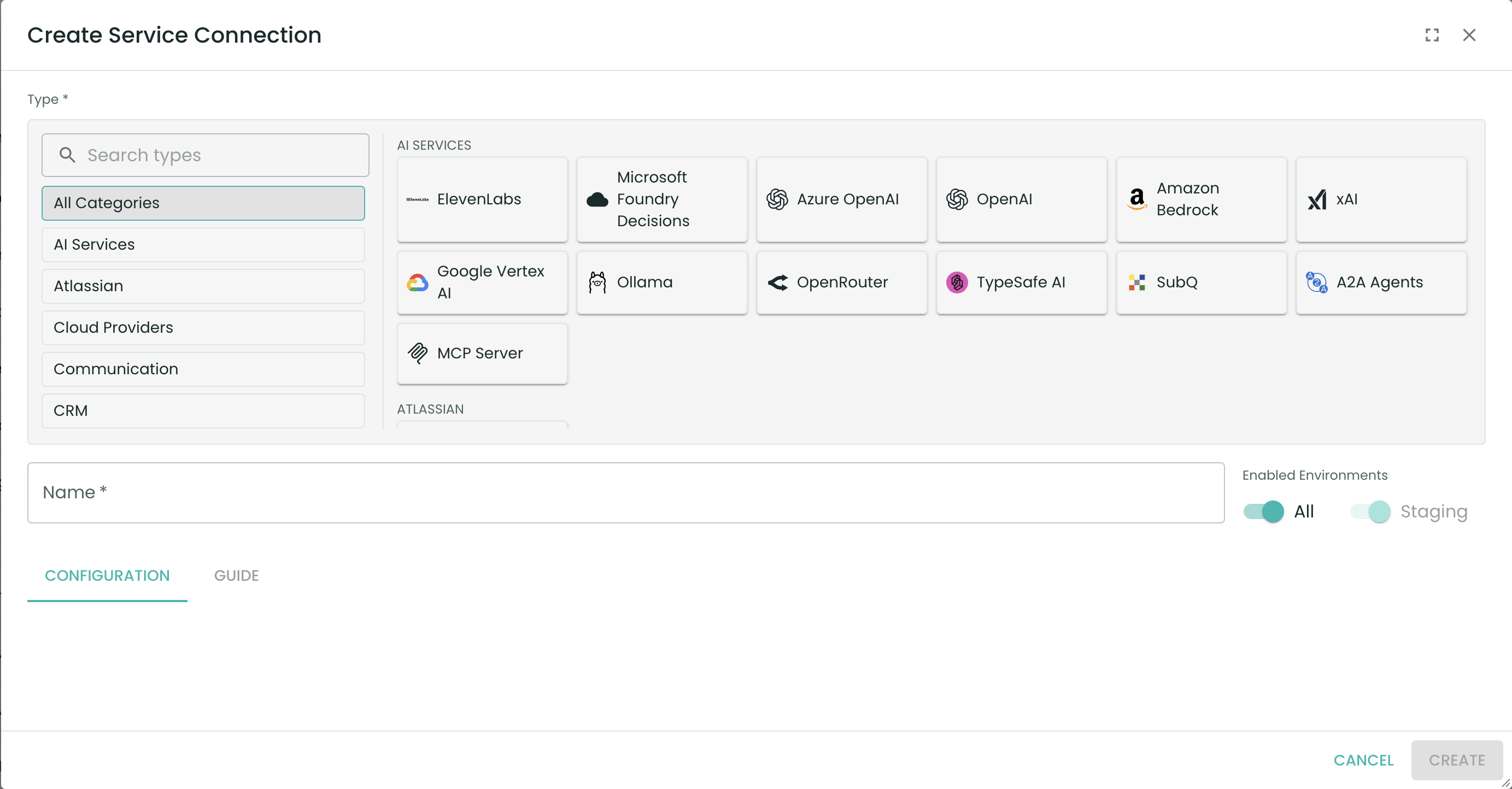
And when you need to connect something specific to your organisation, you can bring your own APIs and services into the same environment.
Whether you are integrating an existing enterprise system, experimenting with a new AI model or introducing another cloud provider, Randol gives you a consistent foundation to build upon.
Connect once. Reuse everywhere. Change providers without rebuilding your solutions.
Your existing technology becomes the foundation for new capabilities, rather than a barrier to building them.
Security
Security is fundamental to Randol. Whether you're managing users, exposing business services, deploying applications or giving intelligent agents access to your systems, every interaction needs the appropriate level of access and control.
Randol provides a consistent security foundation across the platform, helping you govern who can access your solutions, what they can see and what actions they're permitted to perform.
And security doesn't stop at controlling access. Randol also provides auditability and traceability across your services, orchestrations and platform activities, giving you visibility into how your solutions are built and how they operate.
Build with confidence, operate with control and understand what's happening across your platform.
As organisations build more connected solutions, managing security across individual applications, services and integrations can quickly become complex.
Randol brings access management and security controls together, providing a consistent approach across the capabilities you build and deploy.
Rather than recreating permissions and access rules for every new application or orchestration, you can establish security boundaries that apply wherever your business capabilities are used.
Build your security model once, then apply it consistently across your solutions.
Users, roles and permissions
Manage access to your Randol environment and the solutions you create through role-based access control.
Define who can access particular capabilities, what information they can view and which operations they're authorised to perform.
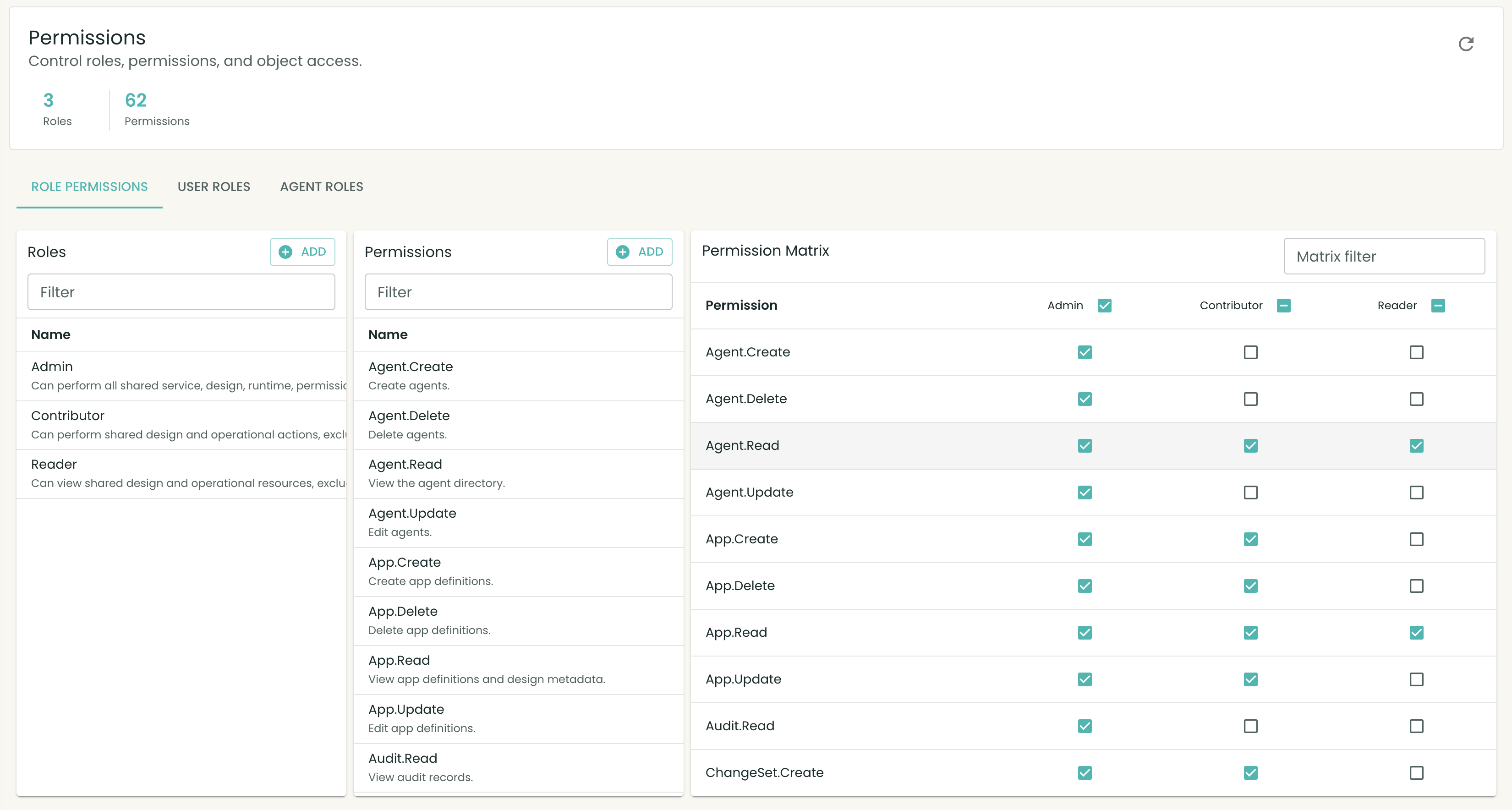
Whether someone is an administrator, employee, customer or external collaborator, their access should reflect their responsibilities and the permissions you've assigned.
Services and business operations
Your services are the systems of record for your business capabilities, so controlling access to them is essential.
Randol allows you to govern access to service operations, ensuring that users and systems interact with business information through the appropriate permissions.
This includes securing APIs through controlled credentials and key management, so integrations can call only the operations they are authorised to use.
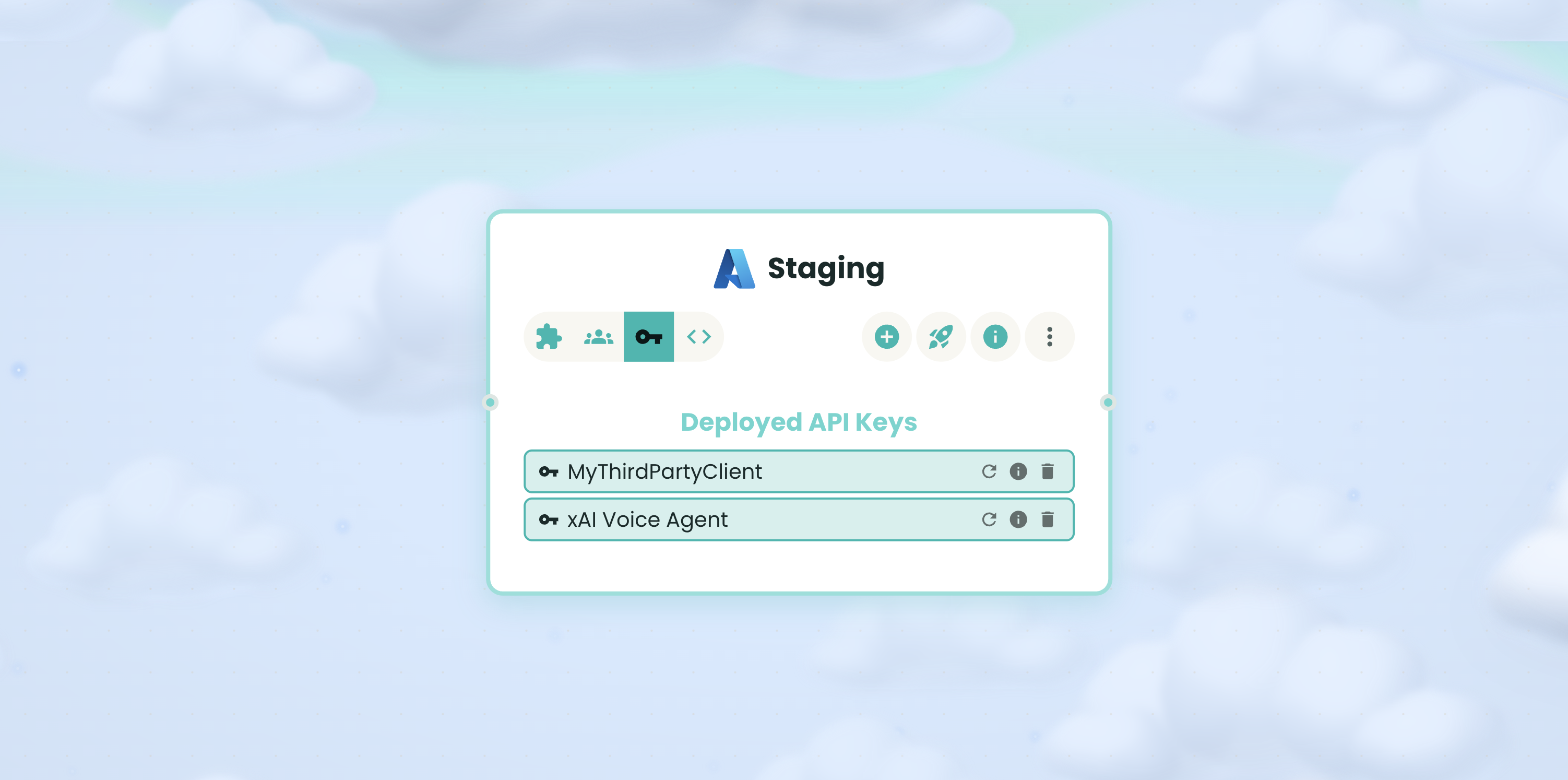
Administrators can create, rotate and manage API keys to maintain secure access across environments and external systems.
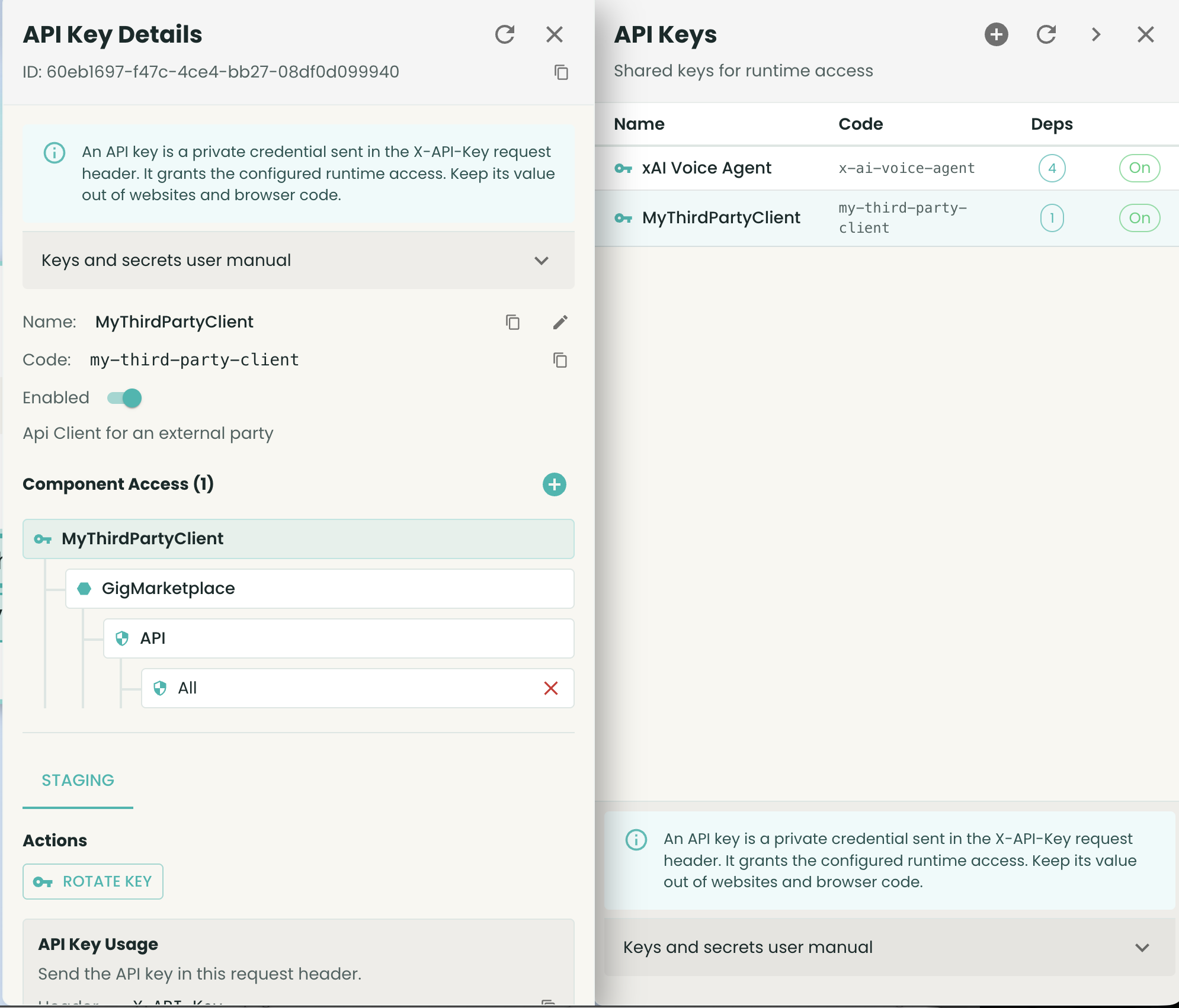
For example, someone might be permitted to view customer information but not modify it. Another user might be able to update records but require additional approval for sensitive actions.
These boundaries help protect the integrity of your business data and ensure that business operations are performed by authorised users and processes.
Applications, interfaces and widgets
Security extends to the experiences you build.
Whether you're creating a complete business application, an internal dashboard, an embedded widget or a customer-facing interface, access should be appropriate to the audience and the functionality being exposed.
Control who can use an application, which capabilities are available to them and how those interfaces interact with your underlying services.
A small embedded form deserves the same consideration for security as a complete enterprise application.
Intelligent agents introduce new opportunities, but they also introduce new security considerations.
An agent might retrieve sensitive information, update business records, initiate payments or interact with external systems. These capabilities must operate within clearly defined security boundaries.
Randol allows you to control which tools and business operations agents can access, while also determining the security context under which they operate.
The right security context for every interaction.
Agents can operate in two ways, depending on the scenario.
Their own security context
An agent can operate under its own identity and permissions, with access to a defined set of capabilities. This is particularly useful for automated processes, background tasks and scheduled orchestrations where an agent needs to perform work independently.
The requesting user's security context
When an agent is interacting with someone through a chat conversation, it can operate within the security context of that user.
This means the agent's access to business information and operations is governed by the permissions of the person making the request.
For example, an employee asking an agent to retrieve customer information should only be able to access records and operations they are authorised to use. Another employee using the same agent may have different permissions and therefore different capabilities available to them.
Intelligence within your security boundaries.
By combining controlled tool access, service-level permissions and flexible agent security contexts, Randol allows intelligent agents to act without bypassing your organisation's security model.
Whether an agent is working independently or acting on behalf of a user, its operations remain subject to the appropriate access controls and business rules.
Give agents the intelligence to act, with the right identity, permissions and control for every interaction.
Knowing who can access a system is important. Knowing what happened, when it happened and how it happened is just as critical.
Randol provides auditing and execution visibility across your services, orchestrations and platform activities, helping you understand how your solutions are being used and how work progresses.
Service call auditing
Your services expose the business operations that applications, agents and external systems rely upon.
Randol provides auditing of service calls, giving you visibility into the operations being invoked and their execution.
This helps you investigate issues, understand how business capabilities are being used and maintain accountability across the systems and processes that depend on them.
Orchestration execution history
Orchestrations can coordinate many activities, including service calls, external integrations, intelligent agents and human decisions.
Randol captures orchestration runs so you can inspect execution history and understand how a process progressed.
Whether you're troubleshooting a failed activity, reviewing the execution of a business process or investigating an agent-driven interaction, you have visibility into the workflow rather than treating it as a black box.
This is particularly important when deterministic logic and agent intelligence work together, allowing you to examine how a process executed and where decisions or actions occurred.
Auditing the way you build
Traceability isn't limited to deployed solutions.
Randol also captures and stores the conversations used to build and configure platform components through its conversational development experience.
This provides a record of the interactions involved in creating and evolving your solutions, helping teams understand the instructions and context behind AI-assisted development.
From defining services to building orchestrations and applications, these records provide an additional layer of transparency around how your platform components are created.
Randol is designed with traceability in mind, from the conversations that help build your solutions to the business operations they perform.
One of the advantages of Randol's architecture is that business capabilities can be reused across different experiences.
A customer record might be accessed through an internal application, a customer service agent, an automated orchestration or an external integration.
Although the way that capability is accessed may change, the underlying security and business rules remain in place.
This allows you to introduce new channels, applications and intelligent agents without having to rebuild the security model for every interaction.
Security isn't simply about restricting access. It's about creating the confidence to expose more of your business capabilities safely.
By combining role-based access, governed business operations, controlled agent capabilities and execution auditing, Randol helps organisations build connected solutions while maintaining appropriate boundaries and visibility.
Whether you're delivering a small internal tool or an enterprise-wide agentic solution, the same principles apply.
The freedom to build and connect more, with the security, governance and traceability to do it responsibly.
Environments
Build, test and deploy your solutions wherever your business needs them.
Randol gives you the flexibility to configure as many environments as your organisation requires, whether that is a simple development and production setup or a more sophisticated landscape spanning multiple teams, regions and cloud providers.
Each environment can be configured to use your preferred infrastructure, services and connections, giving you control over where your solutions run and how they are deployed.
One platform to build your solutions. The freedom to run them where you choose.
Every organisation has different requirements for developing, testing and operating software.
You might need a development environment for experimenting with new capabilities, a staging environment for testing and approvals, and a production environment for your live business operations.
Or you may need multiple production environments for different customers, business units or geographic regions.
Randol lets you configure the environments you need, providing a consistent approach to managing and deploying your solutions across them.
Rather than forcing your organisation into a predefined deployment structure, Randol adapts to the way your business operates.
Randol uses Connections to establish access to the cloud providers and infrastructure that support your environments.
Configure secure connections to your preferred cloud platforms, then use those connections to define where your solutions are deployed.
You can use the same cloud provider across all your environments or choose different providers for different purposes.
For example, you might develop and test a solution using Microsoft Azure, while deploying the production version to AWS. Or you might use different cloud providers for particular parts of your solution, depending on your infrastructure requirements.
This flexibility extends beyond cloud providers. Each environment can also use its own connections to databases, AI models, internal systems and third-party platforms.
Your solution remains consistent, while the technology and infrastructure supporting it can vary by environment.